Lotus Lantern Festival celebrations in South Korea’s capital Seoul drew global attention this year as traditional Buddhist culture merged with modern technology through the appearance of humanoid robot monks.
Held in celebration of Buddha’s Birthday, the historic festival transformed Seoul into a city of lights with colorful lanterns, traditional performances, and massive public participation. The biggest attraction of this year’s event was four robot monks named Gabi, Seokja, Mohui, and Nisa, who joined the parade dressed in traditional Buddhist robes.
During the three-hour procession on Saturday, around 20,000 participants from more than 60 organizations marched through the city. Organizers estimated that nearly 500,000 people attended or watched the festival, significantly higher than last year’s turnout.
The robot monks captivated visitors by greeting crowds, waving their hands, and performing prayer gestures with folded palms. Two additional wheeled robots also joined the procession, displaying messages such as “Healing” and “Hope,” symbolizing the connection between spirituality and technology.
Recently, the robot monk Gabi gained national attention after participating in a Buddhist religious ceremony. Its appearance at the internationally recognized Lotus Lantern Festival further increased global interest in the event.
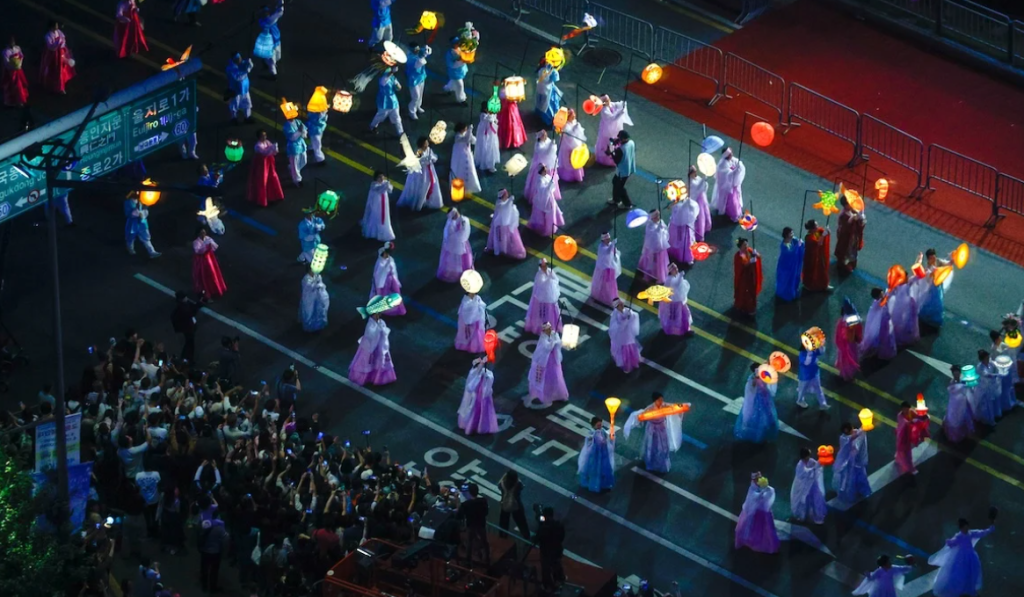
Ancient Buddhist Tradition Meets Modern Technology
In South Korea, Buddha’s Birthday is celebrated as “Bucheonim Osin Nal,” meaning “The Day Buddha Came,” and is observed as a national holiday. The celebration takes place on the eighth day of the fourth lunar month, usually in May. This year’s official religious ceremonies are scheduled for May 24.
Venerable Jinwoo, head of the Jogye Order of Korean Buddhism, addressed participants during the festival and encouraged people to follow the light of truth taught by the Buddha.
He said the festival reminds people to light the lamp of peace within themselves and spread harmony throughout the world. He also emphasized that meditation helps individuals discover inner wisdom and use it for the benefit of society.
The Lotus Lantern Festival has a history of more than 1,200 years dating back to Korea’s ancient Silla Dynasty. Historical records show that royal families celebrated the lantern festival as early as the ninth century.
In 2020, UNESCO recognized the festival as an Intangible Cultural Heritage of Humanity, describing it as a cultural tradition that promotes peace, compassion, and social unity across generations.
This year’s festival also featured strong international participation, including visitors and expatriate communities from Bangladesh, Myanmar, Nepal, and Thailand. Participants wore traditional clothing and carried lanterns representing their own cultures, adding to the festival’s diversity and global atmosphere.
After years of disruption caused by the COVID-19 pandemic, the festival has now fully returned with renewed energy and public enthusiasm. Organizers hope the Lotus Lantern Festival will continue to inspire peace, compassion, and cultural harmony around the world.
More Read>>
Hi, this is a comment.
To get started with moderating, editing, and deleting comments, please visit the Comments screen in the dashboard.
Commenter avatars come from Gravatar.